
Understanding AI in digital marketing
1st Sep, 2026
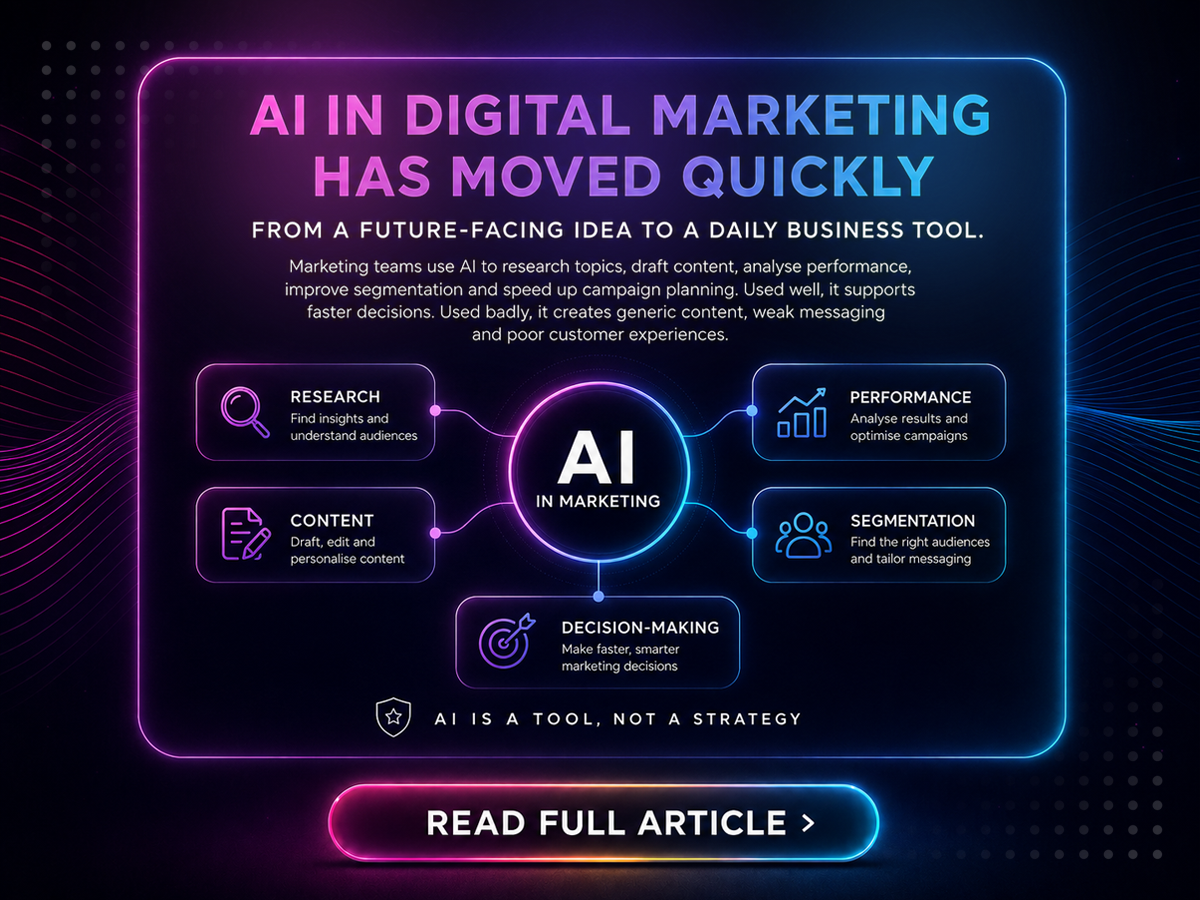
AI in digital marketing has moved quickly from a future-facing idea to a daily business tool. Marketing teams are using it to research topics, draft content, analyse performance, improve customer segmentation and speed up campaign planning. For busy businesses, that sounds like exactly what marketing needs: more output, faster thinking and better use of data.
The challenge is that AI is not a strategy. It is a tool. Used well, it can help a business work faster, identify opportunities and support better decision-making. Used badly, it can create generic content, weak brand messaging, poor customer experiences and campaign decisions that look efficient but damage long-term trust.
For marketing managers, CEOs, CMOs and directors, the real question is not whether AI should be used. The better question is where it should be used, where it needs human control and how it fits into a measurable digital marketing strategy.
What AI in digital marketing really means
AI in digital marketing refers to the use of artificial intelligence tools to support marketing planning, content creation, media buying, customer insight, automation, reporting and optimisation.
This may include tools that help write copy, generate ideas, analyse data, personalise email campaigns, segment audiences, improve ad targeting, recommend keywords or summarise performance reports.
The value of AI is not only speed. Its real value lies in helping teams process information, spot patterns and improve execution. However, it still needs human judgement.
AI can suggest. It cannot fully understand your brand, your customer relationships, your sales conversations or your business priorities without proper direction.
Where AI helps digital marketing
AI can be extremely useful when it supports clear thinking and structured execution. It works best when the business already has a defined strategy, brand position, audience understanding and measurement framework.
-
Research and planning
AI can help marketing teams explore customer questions, competitor themes, search intent, campaign angles and content gaps. It can speed up the early stages of planning by turning rough ideas into useful starting points.
For example, a business can use AI to identify common questions around a service, then use those questions to build blog topics, FAQ sections, email themes or ad concepts. This does not replace strategic research, but it can make the research process more efficient.
-
Content structure and ideation
AI is useful for creating outlines, headline options, content angles and first-draft frameworks. It can help teams move from a blank page to a workable draft faster.
However, the strongest content still needs human input. Your team needs to add industry knowledge, local context, client insight, brand tone and practical value. A generic AI article may fill a page, but it will rarely build trust with a serious decision maker.
-
Campaign optimisation
AI can support campaign optimisation by analysing performance patterns and identifying possible improvements. In paid media, automated bidding and machine learning can help platforms optimise towards conversions, audience signals and budget efficiency.
The key is control. AI-powered campaign tools still need the right conversion tracking, creative direction, landing pages and performance review. If the wrong goal is fed into the system, the system may optimise towards the wrong result.
-
Reporting and insight
AI can help summarise data, highlight changes and turn campaign reports into clearer management notes. This is valuable for leadership teams that need to understand what happened, why it happened and what should happen next.
A strong report should never only show activity. It should explain performance. AI can help organise the information, but the agency or marketing team must still interpret the data in relation to business goals.
Where AI can hurt marketing performance
AI becomes risky when it is used as a shortcut for strategy, quality or accountability.
-
Generic content weakens brand trust
One of the biggest risks is generic content. AI can produce content quickly, but fast content is not always useful content. If every article, caption or email sounds like it could belong to any business in any industry, your brand loses personality.
Decision makers are not looking for filler. They want useful answers, clear insight and confidence that your business understands their problem. Poor AI content may look efficient internally, but it can feel empty to the reader.
-
Wrong information can damage credibility
AI tools can produce inaccurate, outdated or misleading information. This is especially risky in industries where technical accuracy, legal compliance or financial claims matter.
Every AI-assisted output should be checked. Facts, statistics, product details, service claims, pricing references and legal statements must be verified before publication. Responsibility remains with the business, not the tool.
-
Automation can create poor customer experiences
AI-powered chat, email automation and lead nurturing can improve response speed, but they can also frustrate customers when poorly implemented.
If automation sends irrelevant messages, misunderstands enquiries or pushes people through the wrong journey, it can reduce trust. Customers should feel supported, not processed.
-
Poor measurement can hide weak results
AI tools can make reporting look impressive, but polished dashboards do not always mean better performance. If marketing is measured on clicks, impressions or engagement alone, AI may help increase activity without improving commercial outcomes.
This is where businesses need clear measurement. A campaign should be judged by lead quality, conversion rate, sales fit, pipeline contribution and customer value, not only by surface-level metrics.
How AI fits into a digital marketing strategy
AI should support the strategy, not define it.
A proper digital marketing strategy starts with business goals, audience understanding, market positioning, channel selection and measurement planning. Once those elements are clear, AI can help teams execute more efficiently.
For a foundation-stage business, AI may support website content planning, SEO research and reporting setup. For a growth-stage business, it may help with campaign testing, landing page messaging and lead journey improvement. For a scale-stage business, AI may support segmentation, personalisation, forecasting and performance analysis.
The business must first know what it is trying to achieve. Only then can AI be used in the right places.
Responsible AI use needs governance
Responsible AI in digital marketing requires rules. Without governance, teams can quickly create inconsistent, inaccurate or off-brand work.
A practical AI governance approach should define where AI may be used, who reviews AI-assisted work, which claims require proof, how customer data is handled and which outputs need final approval before publication.
Businesses should also decide what should never be fully automated. Brand strategy, final content approval, sensitive customer communication, legal claims, pricing promises and campaign decisions with commercial impact should always involve human judgement.
Governance is not there to slow marketing down. It protects the business while allowing the team to use AI with confidence.
Quality control is where the real value sits
The difference between weak AI use and strong AI use is quality control.
A responsible process should include human review, fact checking, brand tone editing, SEO alignment, customer relevance checks and performance review after publication.
Before AI-assisted content goes live, ask whether it answers a real customer question, includes practical insight, reflects the brand voice and gives the reader something useful. Before AI-assisted campaign changes are accepted, ask whether the data supports the recommendation and whether the change aligns with the business goal.
AI can help produce the draft, but quality control creates the value.
How to measure AI’s impact
If AI is being used in digital marketing, its impact should be measured. The question should not only be whether AI saved time. It should also be whether it improved quality, performance or decision-making.
Useful measures may include content production efficiency, organic visibility, engagement quality, lead conversion rate, cost per qualified lead, time saved in reporting and improved campaign response.
The most important measure is business value. If AI helps the team publish more but the content does not attract better traffic or support stronger enquiries, it is not adding enough value.
This is where a Digital Health Audit can help. It gives businesses a clearer view of what is working, where performance is being lost and which parts of the marketing system need stronger structure before more tools are added.
Choosing the right level of AI support
Not every business needs complex AI systems. Many businesses simply need a smarter way to plan, execute and measure digital marketing.
Some may need AI-supported content workflows. Others may need better reporting, campaign optimisation or lead qualification. The right level of support depends on the business goal, internal capacity, budget and maturity level.
Ideation Digital’s digital packages hub is a useful starting point for businesses that want structured digital marketing support without adding disconnected tools or unnecessary complexity.
Use AI to sharpen the strategy, not replace it
AI in digital marketing can help businesses move faster, plan smarter and improve execution. It can support research, content development, campaign optimisation, reporting and customer journeys. But it can also hurt performance when it is used without strategy, governance or quality control.
The businesses that benefit most from AI will not be the ones that automate everything. They will be the ones that combine smart tools with strong human judgement, clear measurement and a focused digital marketing strategy.
If your business is exploring AI but wants to use it responsibly, Ideation Digital can help you take a more structured approach. Start with a Digital Health Audit to understand where your current marketing stands, then build a focused digital marketing strategy that uses AI where it adds value, not where it creates risk.
Speak to Ideation Digital today and turn AI from a marketing shortcut into a smarter, measurable growth support system.