
Best digital marketing platforms for businesses in SA
1st Aug, 2026
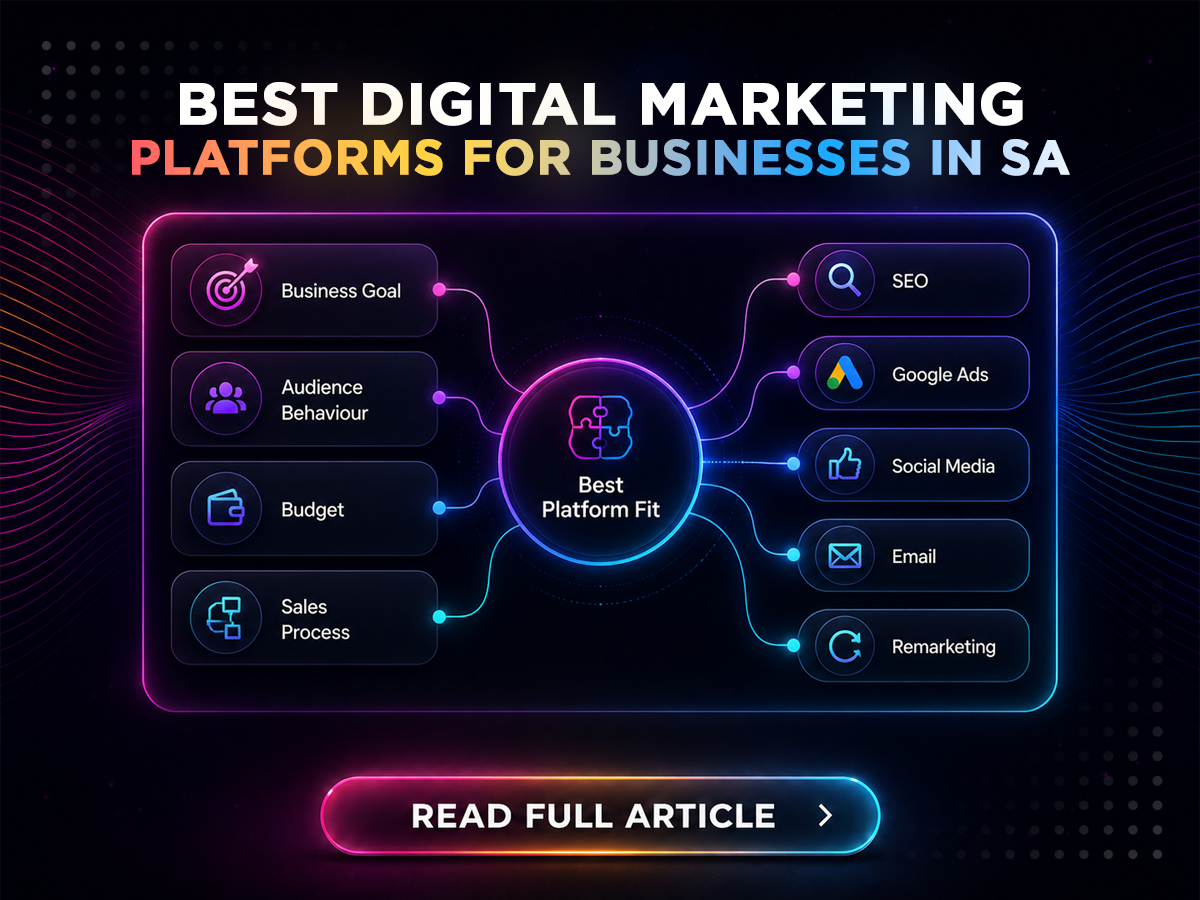
Choosing the best digital marketing platform for your business is not about following the loudest trend. It is about choosing the platform that matches your business goal, audience behaviour, budget and sales process.
For South African businesses, this decision has become more important than ever. Marketing managers, CEOs, CMOs, directors and business decision makers are under pressure to show performance, improve lead quality and make every rand work harder. The problem is that many businesses choose platforms too quickly. They hear that Google Ads works, LinkedIn is good for B2B, or TikTok is growing, then they invest without a clear strategy.
A digital marketing platform should never be selected in isolation. It should form part of a bigger digital marketing strategy that connects awareness, lead generation, e-commerce, retention and reporting. The right platform helps you reach the right people. The right strategy helps you turn that attention into measurable business growth.
What is a digital marketing platform?
A digital marketing platform is any online channel or system that allows your business to reach, engage, convert or retain customers. This can include Google Search, Google Ads, Meta, LinkedIn, TikTok, YouTube, email marketing, SEO, your website, ecommerce platforms and CRM tools.
The important point is that not every platform serves the same purpose.
Some platforms are strong for visibility.
Others are better for high-intent leads.
Some support online sales.
Others help you nurture existing clients and increase repeat business.
That is why platform choice should start with a business goal, not a preference.
Start with the goal before choosing the platform
Before choosing any digital marketing platform, ask one simple question: What must this platform help the business achieve?
A business that needs stronger brand awareness should not use the same platform mix as a business that needs urgent lead generation. An e-commerce company should not measure success in the same way as a professional services firm. A business with a long sales cycle needs different nurturing tools from a business selling fast-moving products online.
This is where a structured strategy becomes essential. Ideation Digital’s Digital marketing strategy service helps businesses move away from disconnected activity and build a clear digital roadmap based on objectives, audience behaviour and measurable outcomes.
Practical platform selection matrix by goal
|
Business goal |
Best-fit digital marketing platforms |
Why they work |
Key measurement focus |
|
Awareness |
Meta, TikTok, YouTube, Google Display, SEO content |
Helps build visibility, reach and brand recall |
Reach, engagement, video views, branded search growth |
|
Lead generation |
Google Search Ads, SEO, LinkedIn Ads, landing pages, remarketing |
Captures demand and turns interest into enquiries |
Leads, cost per lead, conversion rate, lead quality |
|
Ecommerce sales |
Google Shopping, Performance Max, Meta Ads, email, ecommerce SEO |
Drives product discovery, sales and repeat purchases |
Revenue, ROAS, cart value, abandoned cart recovery |
|
Retention |
Email marketing, CRM, remarketing, social community content |
Keeps your brand visible to existing customers |
Repeat purchases, engagement, customer lifetime value |
This matrix is not a fixed rule. It is a starting point. The right platform mix depends on your industry, audience, sales cycle, location and available budget.
Best platforms for awareness
Awareness platforms help people discover your business before they are ready to buy. This is important because many customers do not search for a supplier immediately. They first need to recognise a problem, understand a solution or become familiar with a brand.
Meta platforms, including Facebook and Instagram, are useful for visual storytelling, brand education, product visibility and community engagement. They work well for businesses that need consistent market presence.
TikTok can be valuable for brands that can create short, useful and entertaining content. It is not only for younger audiences anymore, but it does require a strong content approach.
YouTube works well for businesses that need to educate, demonstrate or explain. It is powerful for complex products, professional services and industries where trust takes time to build.
SEO content is also a strong awareness platform. Articles, guides and service pages help your business appear when potential customers are researching a topic. This builds organic visibility and supports long-term credibility.
Best platforms for lead generation
Lead generation platforms are used when the business needs enquiries, calls, form submissions or booked consultations. These platforms should be selected with intent in mind.
Google Search Ads are often one of the strongest lead generation platforms because they capture people who are actively searching for a product or service. The user already has intent. The role of the campaign is to match that intent with the right offer, landing page and call-to-action.
SEO is also valuable for lead generation, especially when your website ranks for high-intent search terms. A well-structured SEO strategy can reduce reliance on paid media over time and build stronger organic lead flow.
LinkedIn Ads can be effective for B2B businesses that need to reach decision makers, professionals or niche industry audiences. The platform can be more expensive than other channels, so it should be used with clear targeting, strong messaging and proper lead qualification.
Landing pages are not always seen as platforms, but they are critical to lead generation. A campaign is only as strong as the page it sends traffic to. If your landing page is unclear, slow or too generic, you may pay for traffic that does not convert.
Best platforms for e-commerce
For ecommerce businesses, platform selection must focus on revenue, product visibility and the customer journey.
Google Shopping and Performance Max are powerful for product-led businesses because they connect users with relevant products at the point of search and discovery. These platforms work best when product feeds, pricing, images and website conversion tracking are properly set up.
Meta Ads can support ecommerce by driving product discovery, remarketing and promotional campaigns. It is especially useful when products have strong visual appeal or when customers need repeated exposure before buying.
Email marketing plays a major role in e-commerce retention. Welcome flows, abandoned cart emails, product recommendations and post-purchase communication can help increase revenue without relying only on new traffic.
E-commerce SEO is also important. Category pages, product descriptions and helpful buying guides can support long-term organic sales while improving the customer experience.
Best platforms for retention
Retention is often overlooked, but it is one of the most valuable parts of digital marketing. Many businesses focus all their energy on new leads while neglecting existing customers.
Email marketing is one of the strongest retention platforms because it allows direct communication with people who already know your brand. It can be used for education, offers, updates, product launches and customer nurturing.
CRM platforms help businesses manage relationships, track lead progress and understand where opportunities are sitting in the sales process. For B2B companies, CRM alignment is especially important because leads may take weeks or months to convert.
Remarketing helps your business stay visible to people who have already visited your website, engaged with your content or interacted with previous campaigns. It is useful for both lead generation and retention because it keeps your brand present during the decision-making process.
Why your website is still the centre of the platform mix
No matter which digital marketing platform you choose, your website remains the central conversion point. Paid ads, social media, SEO, email and remarketing often lead people back to your website.
If the website does not explain your value clearly, load properly, build trust or make enquiry easy, platform performance will suffer. Businesses sometimes blame Google Ads or social media when the real issue is the conversion journey.
A good website should support every stage of the funnel. It should educate, position your business, answer common questions, guide visitors to the right service and make the next step obvious.
How to avoid choosing the wrong platform
The wrong platform is not always a bad platform. It may simply be wrong for your goal.
A business may invest in social media when it actually needs high-intent search traffic. Another may push Google Ads before fixing its landing pages. An e-commerce brand may spend heavily on acquisition while ignoring email retention. A B2B company may chase reach when it needs decision-maker engagement.
This is why Ideation Digital’s Digital Health Audit is a valuable starting point. It helps identify where your current digital performance is strong, where gaps exist and which platform decisions should be prioritised.
Budget should follow strategy
Platform decisions should also be tied to budget. Not every business needs every channel at once. A smaller budget may need to focus on fewer platforms with stronger intent. A larger budget may support a more integrated mix across awareness, lead generation, remarketing and retention.
Ideation Digital’s digital packages hub is useful for businesses that want to understand how digital marketing investment can be structured according to growth stage, objectives and the level of strategic support required.
The goal is not to spend more everywhere. The goal is to invest in the platforms most likely to move the business forward.
Build a platform ecosystem, not a platform list
The strongest digital marketing results happen when platforms work together.
Google Ads can capture demand.
SEO can build long-term visibility.
Social media can build trust.
Email can nurture prospects.
Remarketing can bring people back.
Your website can turn interest into action.
When these elements are connected through one strategy, performance becomes easier to measure and improve.
A digital marketing platform should never operate as a standalone activity. It should form part of an ecosystem designed around your business goals.
Choose the platform that matches the outcome
The best digital marketing platform for your business is the one that supports your next growth objective.
For awareness, you may need social, video and SEO content.
For lead generation, you may need Google Search Ads, SEO, landing pages and remarketing.
For e-commerce, you may need Google Shopping, Meta Ads, email and e-commerce SEO.
For retention, you may need email, CRM and remarketing.
The platform matters, but the strategy behind it matters more.
If your business is unsure which platforms deserve budget, attention and priority, Ideation Digital can help you make a clearer decision. Start with a Digital Health Audit, explore a tailored digital marketing strategy or review the digital packages hub to understand the level of support your business needs.
Speak to Ideation Digital today and build a platform mix that works harder, connects better and supports measurable business growth.